19 October, 2026
Monday
Ai
RAGFlow v0.25.4 Adds Generic RESTful API Connector and New OpenAI Models
RAGFlow v0.25.4 Adds Generic RESTful API Connector and New OpenAI Models
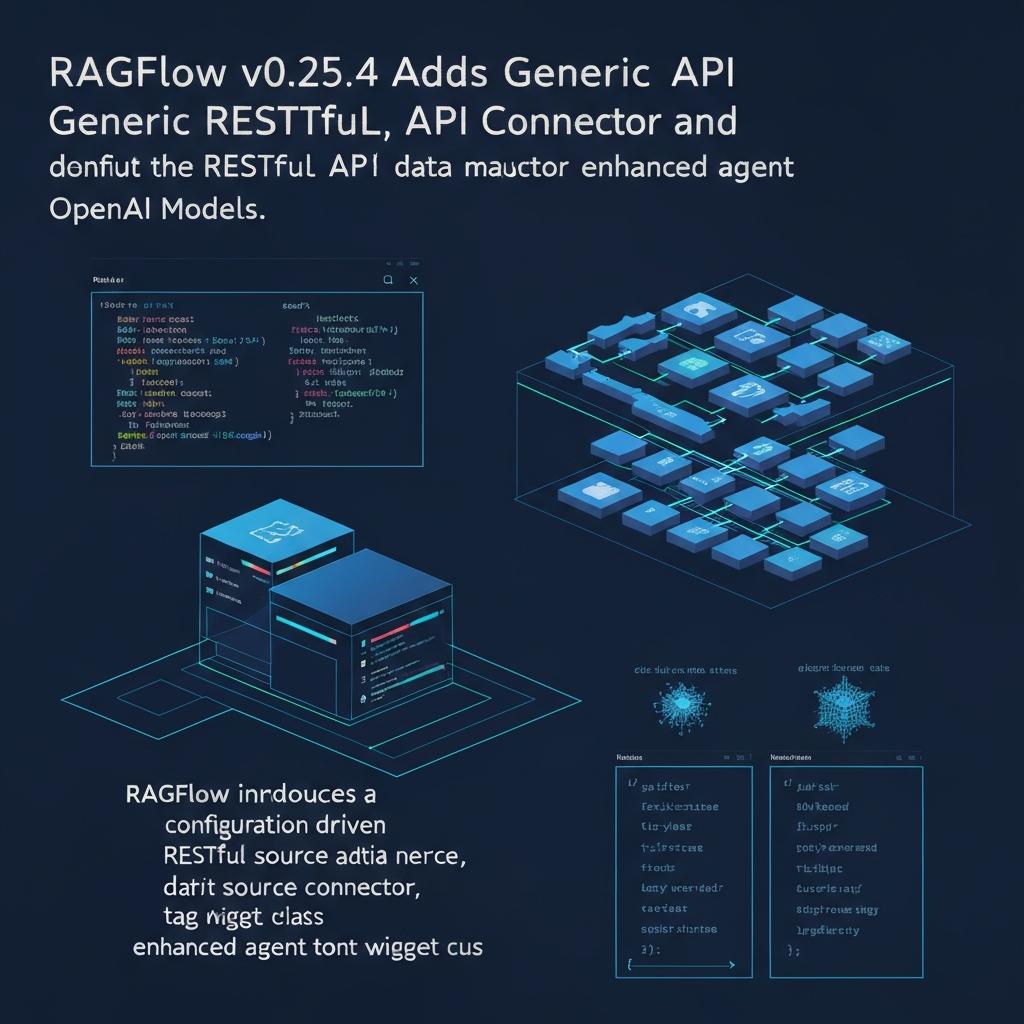
RAGFlow v0.25.4 is out, and it's a meaningful step forward for anyone building knowledge-intensive AI workflows. The headline feature: a new, configuration-driven RESTful API data source connector. Instead of writing custom code to pull data from external APIs, you can now define endpoints, authentication, and parsing rules through configuration files. This drastically reduces the time needed to connect new data sources — from days to minutes.
What Changed
Generic RESTful API Connector. The core addition is a generic, configuration-driven connector that lets you ingest data from any RESTful API without writing code. You simply provide a configuration file specifying the endpoint, headers, query parameters, and how to parse the response. It's designed for teams that need to federate data across multiple services quickly.
Agent Tag Management. Tag management for agents now includes filtering and sorting. This might sound minor, but for organizations with dozens of agents running different pipelines, it's a real time-saver. You can now quickly find agents by tag and order them by creation date or name.
Widget Customization and Persistence. Widgets used in the dashboard can now be customized and their states persist across sessions. This means you can set up the exact views you need for monitoring agent performance or data pipelines and have them stick.
New OpenAI Models. RAGFlow now supports OpenAI's gpt-5.4-mini and gpt-5.4-nano. These are presumably smaller, cheaper variants of the gpt-5 series, optimized for speed and cost in simple reasoning tasks.
Bug Fix. One bug fix: the dataset document download route now works correctly. That's a small but important fix for users who need to export their data.
Why It Matters
RAGFlow's strength has always been about connecting retrieval-augmented generation pipelines to diverse data sources. The previous approach required custom connectors, which meant a developer had to be involved for every new API. The new configuration-driven model flips that: now a data engineer or even a savvy product manager can plug in a new source using a config file. That's a big deal for scaling knowledge bases.
The agent tag management and widget persistence improve the user experience for heavy users. These aren't flashy features, but they reduce friction in daily operations. It's the kind of polish that separates a tool from a platform.
Adding the new OpenAI models is smart. Not every task needs a full gpt-5 — sometimes you just need a fast, cheap inference call. By supporting the mini and nano variants, RAGFlow gives users cost flexibility.
One thing I'd have liked to see: more details on the configuration format for the API connector. Is it YAML? JSON? Examples? The lack of specifics might slow adoption. Still, this is a solid release that moves RAGFlow in the right direction — less code, more configuration.
Official Source: https://github.com/infiniflow/ragflow/releases/tag/v0.25.4
Tags:
What's your reaction?
0

AWESOME!
0

LOVED
0

NICE
0

LOL
0

FUNNY
0

EW!
0

OMG!
0

FAIL!
Recent News

08 Aug 2026